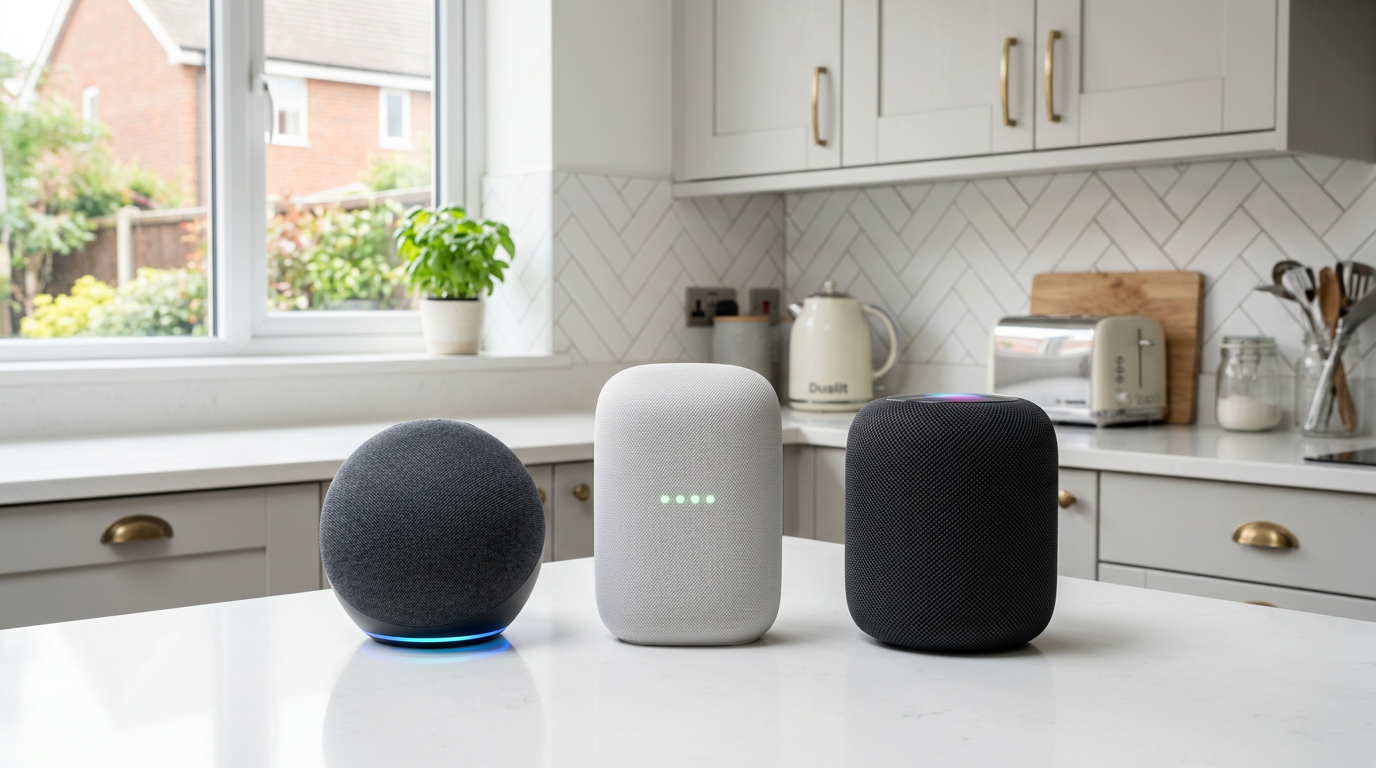
The smart speaker market has settled into a clear three-way competition. Amazon's Echo range, Google's Nest Audio family, and Apple's HomePod hold the vast majority of UK households between them. Each has meaningful strengths and notable limitations, and the right choice depends significantly on what you already own and what you actually want a speaker to do.
Accent and Dialect Recognition
This is the question UK buyers consistently raise, and with good reason. All three devices have improved considerably on regional accent recognition since their early iterations, but meaningful differences remain.
Amazon Echo (Alexa) has spent more years building its UK dataset and handles a broad range of regional accents — including Scottish, Welsh, Northern Irish and various English regional dialects — with reasonable reliability. It tends to struggle more with very strong accents combined with background noise.
Google Nest (Google Assistant) leverages Google's more extensive speech recognition infrastructure and performs comparably or better on standard UK accents. Its handling of questions that benefit from web search — which covers a lot of everyday queries — is stronger than Alexa's.
Apple HomePod (Siri) lags behind both competitors on accent recognition for non-standard UK dialects, though it performs well for the accents most heavily represented in Apple's UK user base. Siri has also historically been weaker on general knowledge queries than either Alexa or Google Assistant.
Smart Home Compatibility
If you have, or plan to build, a smart home setup, this is probably the most important practical consideration.
All three now support the Matter protocol, which standardises smart home device communication across ecosystems. This has reduced — though not eliminated — compatibility headaches. In practice:
- Echo is compatible with the widest range of smart home devices, including many that pre-date Matter. Its Zigbee hub (built into some models) allows direct control of Zigbee devices without additional hubs.
- Google Nest integrates tightly with Google Home devices and works well with a broad range of third-party devices. Its routines and automation are more flexible than Alexa's in some respects.
- HomePod requires Apple HomeKit compatibility, which is narrower than Alexa or Google but has expanded significantly with Matter adoption. If your household is deeply invested in Apple devices, the integration is seamless; otherwise, device choice is more constrained.
Sound Quality
The Apple HomePod (full-size) leads on pure audio quality — it is genuinely competitive with standalone Bluetooth speakers at a similar price. The HomePod mini, at around £99, punches above its weight for music listening in smaller rooms. The Amazon Echo (4th generation) and Google Nest Audio both offer decent sound at their respective price points but are not primarily music-listening devices. For background audio and radio, all three are perfectly adequate; for attentive music listening, Apple holds the advantage.
Privacy
All three devices involve a microphone that is, at minimum, listening for a wake word. The privacy practices of each company differ in important ways:
Amazon and Google both use voice data to improve their services, with opt-out options available in settings. Apple processes Siri requests on-device where possible and applies stricter data minimisation principles. For users who are privacy-conscious, Apple's approach is generally considered more protective, though all three offer options to delete recordings and limit data use.
Price Comparison (2026)
| Device | Entry price | Mid-range | Premium |
|---|---|---|---|
| Amazon Echo | Echo Pop — ~£35 | Echo (4th gen) — ~£99 | Echo Studio — ~£199 |
| Google Nest | Nest Mini — ~£49 | Nest Audio — ~£89 | – |
| Apple HomePod | HomePod mini — ~£99 | – | HomePod — ~£299 |
Which Should You Choose?
The practical answer depends on your situation:
- Widest device compatibility and best value: Amazon Echo. The range of supported devices and the entry-level price point make it the default recommendation for most households starting with smart speakers.
- Best general knowledge and web-connected queries: Google Nest Audio. Google's search integration gives it an edge for factual questions and information requests.
- Apple household or audio quality priority: Apple HomePod. If you are already in the Apple ecosystem and want the best sound quality from your smart speaker, HomePod justifies its premium.
Before You Buy
Check whether your existing smart home devices are compatible with the ecosystem you are choosing. Most retailers offer a 30-day return window on smart speakers; consider using it to test accent recognition in your home before committing.