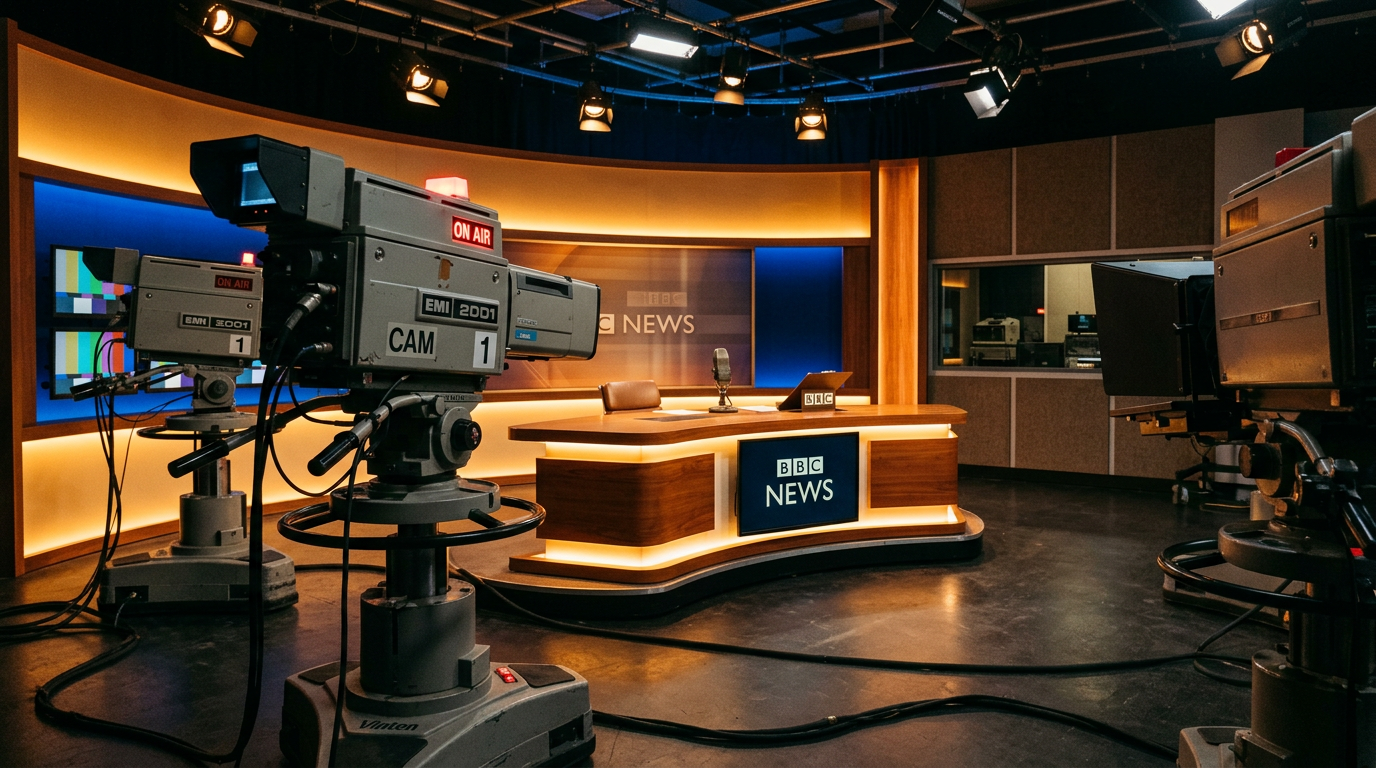
Live television is, by its very nature, an exercise in controlled chaos. Scripts are rehearsed, autocues are loaded, and producers stand off-camera armed with clipboards and worried expressions. Yet no amount of preparation can entirely insulate a broadcast from the unpredictable — a rogue prop, a too-candid interviewee, a technical failure arriving at the worst possible second, or simply a presenter whose composure deserts them at exactly the wrong moment.
British audiences have, over the decades, been treated to an unusually rich collection of these unscripted occasions. Some have become folklore; others circulate endlessly on video compilation programmes, greeted each time with the same delighted recognition. Here is a tour through some of the most memorable.
The Countdown Ferret Incident
Richard Whiteley, the long-running host of Channel 4's afternoon word game Countdown, was a man of unfailing good humour and a certain distinguished calm. In 1977, well before the show began its Channel 4 run, Whiteley was presenting a regional news piece that involved a ferret. The ferret, as ferrets reliably do, decided to assert its independence by biting Whiteley firmly on the hand. Whiteley's expression — a masterclass in trying to maintain composure while an animal refuses to cooperate — has entered the canon of British broadcast mishaps.
What makes the clip endure is not simply the bite, but Whiteley's valiant attempt to carry on as though nothing unusual had occurred. That stoicism in the face of ferret-based adversity is quintessentially British.
When the Weather Map Misbehaved
The BBC weather forecast has, over the years, suffered several celebrated technological failures. Perhaps the most fondly remembered class of incident involves the graphic overlays — those animated maps of pressure systems, fronts and precipitation — developing a life of their own. Scotland has, on more than one occasion, been relocated. Clouds have sat stubbornly over clear-skied counties. Presenters have stood pointing at a map that was showing entirely the wrong chart.
In one particularly memorable moment, a forecast for the southeast of England was accompanied by a graphic depicting heavy snow across the entire British Isles — in late June. The presenter, to their credit, noticed immediately and managed to flag the error before viewers had entirely updated their summer holiday plans.
The Newsreader and the Giggle
Newsreaders occupy a peculiar professional position: they must deliver stories of every conceivable emotional register — tragedy, triumph, absurdity — with identical, measured composure. Occasionally, this composure fails spectacularly.
The phenomenon of the live-television giggle is well documented. Typically it follows a story that is, in isolation, genuinely funny — an escaped animal causing chaos in a town centre, a local official making an ill-chosen turn of phrase, a pun in a headline that the reader only fully registers on air. Once the giggle begins, it tends to be self-perpetuating. The harder the newsreader tries to suppress it, the worse it becomes.
"Once the giggle begins, it tends to be self-perpetuating. The harder the newsreader tries to suppress it, the worse it becomes."
The BBC's own archives contain several examples, and the incidents reliably produce more warmth and goodwill toward the presenters involved than almost any other kind of broadcast moment. Audiences, it turns out, enjoy seeing the people on television behave like people.
Live Satellite Link Failures
The live satellite link is a staple of rolling news, and its failure is almost equally staple. The format is familiar: a presenter in the studio, a correspondent standing in front of a location — usually a building relevant to the story, occasionally a building that is entirely unrelated but happened to have a suitable backdrop. The link connects. There is a half-second delay. And then either the audio drops out, or the video freezes on the correspondent mid-gesture, or both.
The resulting exchanges are often exquisitely awkward. "Can you hear me, John?" "Yes, I can hear you — can you hear me?" Long pause. "We seem to have lost that link, but we'll try to return to our correspondent later." The correspondent, frozen on screen in a particularly unfortunate expression, remains visible for several seconds.
The Unexpected Studio Visitor
Animals, children and structural surprises constitute the holy trinity of live television disruption. Children invited onto programmes to present a project or demonstrate a skill have a long history of either freezing completely, or conversely saying something so startlingly candid that the entire production comes to a gentle halt while the presenter recovers.
A particularly charming category involves animals brought into breakfast television studios. A snake that chose to explore the desk. A parrot that added its own editorial to a political discussion. A tortoise that moved, with great deliberateness, across the shot at precisely the wrong moment. Morning television, with its slightly looser format and longer running time, has absorbed these interruptions with characteristic good grace.
The Wrong Footage Problem
Before fully digital editing suites made clip management more reliable, the wrong footage appearing over a news report was an occupational hazard. The reporter would be solemnly describing one event while images of something entirely different appeared on screen — a factory in Coventry shown while discussing a harbour development in Aberdeen, stock footage of the wrong city, or on one occasion, footage from a previous year's story that contradicted the entire thrust of the current one.
These errors rarely escaped notice from viewers, who were prompt in writing — later emailing, later tweeting — to point them out. The corrections, when they came, were delivered with the specific deadpan of a broadcaster acknowledging that yes, they know, and they are very sorry.
Presenters Talking Over Each Other
Co-presenting formats, particularly on breakfast and daytime television, have a wonderful tendency to produce moments where both presenters attempt to introduce the same item simultaneously, then both stop to let the other go, then both start again. This can cycle through several iterations before one of them, by sheer force of will or a very decisive glance, takes control. The chemistry required for smooth co-presenting is, it turns out, genuinely difficult to manufacture, and the moments when it briefly fails have a warm, collegial quality.
Why We Love These Moments
There is a reason these clips endure and are compiled, broadcast again and watched afresh by each generation. Live television, at its best, reminds viewers that the people on screen are human beings — fallible, sometimes surprised, occasionally overtaken by laughter or circumstance. The composure that professional broadcasters maintain most of the time is all the more impressive for those moments when it briefly, engagingly, slips.
The British tradition of affectionate response to broadcast mishaps — rather than outrage or embarrassment — says something characteristic about the culture. There is a particular pleasure in seeing things go wrong in a way that harms nobody and produces a moment that people are still quoting thirty years later.
Did You Know?
The BBC's own programme It'll Be Alright on the Night, first broadcast in 1977 and presented by Denis Norden, was one of the earliest formats built entirely around broadcast outtakes and live errors. It ran for over twenty years, suggesting the appetite for this kind of material is both genuine and persistent.
If you have a favourite British live television mishap that should be on this list, or a moment you remember that has been quietly forgotten — you can reach us at our contact page. We are always collecting.