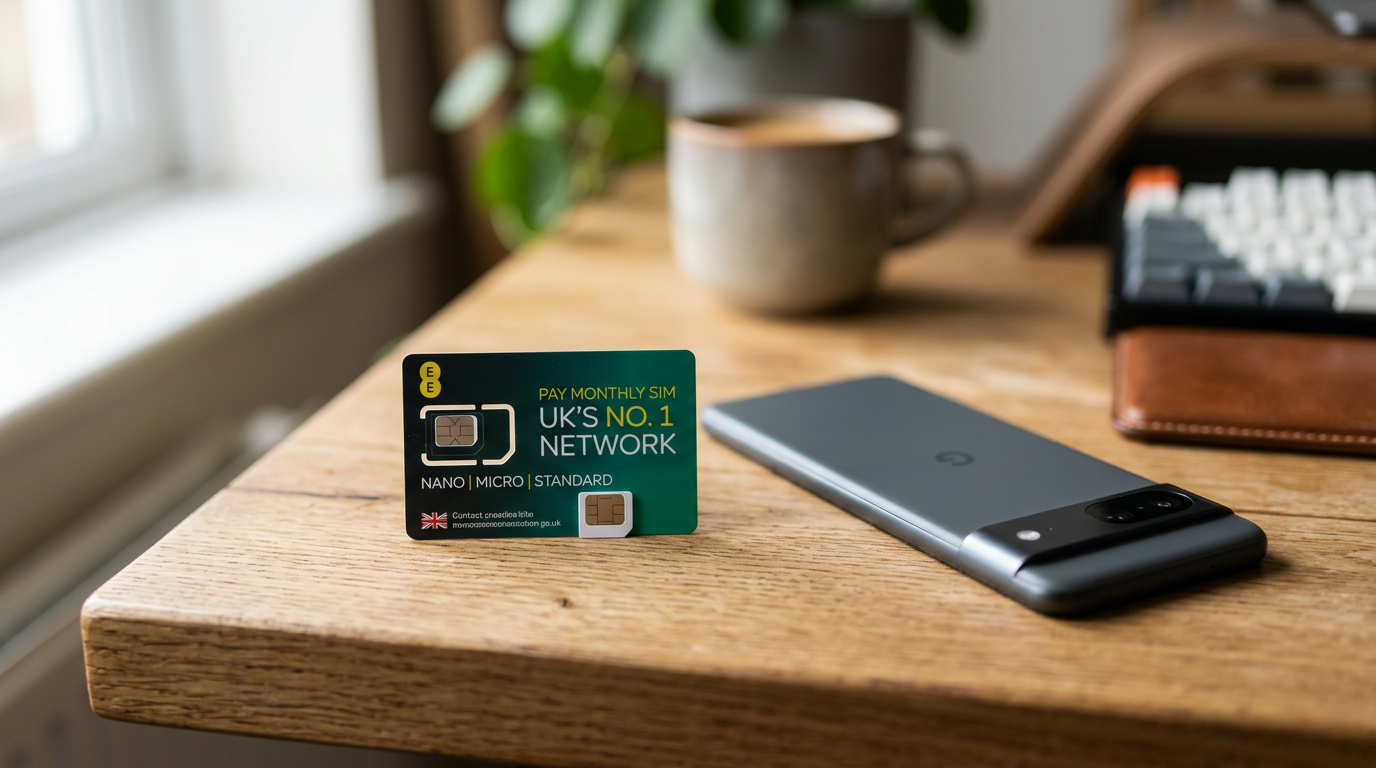
If you own your handset outright — whether purchased separately, passed down, or kept after a previous contract ended — a SIM-only plan is almost always better value than a handset contract at the same monthly cost. The reasons are straightforward: you are not financing a device, so the monthly payment covers only service. The complication is that the SIM-only market has become large enough that comparing plans meaningfully requires attention to details that are not always prominent in the advertising.
The Four Main Networks
The UK has four main mobile network operators: EE, Vodafone, O2, and Three. Most other providers — including Giffgaff, iD Mobile, SMARTY, Lebara and dozens more — are MVNOs (Mobile Virtual Network Operators) that run on one of these four networks' infrastructure.
Choosing between a main network and an MVNO often comes down to price versus priority. During periods of high network congestion, some MVNOs are deprioritised in favour of the host network's own customers. The difference in everyday use is usually unnoticeable; in very busy locations at peak times, it can occasionally be significant.
5G: What You Are Actually Getting
5G coverage in the UK has expanded considerably since 2020 but remains geographically concentrated. As of 2026, 5G outdoor coverage is broadly available in most UK city centres and large towns, but rural and suburban coverage is patchy on all networks.
All four main networks include 5G on their standard plans now, but check coverage maps for your specific area before paying a premium for 5G-marketed plans. Three has historically had strong 5G coverage in cities; EE has the broadest overall network footprint including 4G in rural areas.
Data Caps and Throttling
Most SIM-only plans are now sold as "unlimited data," but this term requires scrutiny. True unlimited plans with no throttling at any point exist but are typically at the higher price tier. Many "unlimited" plans include:
- Soft caps: Speed is reduced after a certain data threshold (commonly 50GB or 100GB per month). The reduced speed — often to 2Mbps — is sufficient for basic browsing but will affect video streaming.
- Hotspot restrictions: Some plans limit how much data can be used as a personal hotspot (tethering), even when phone data is unlimited.
- Roaming restrictions: Unlimited data often applies only in the UK; roaming allowances are specified separately.
Roaming After Brexit
Post-Brexit, the automatic right to roam in the EU at no extra cost (which was guaranteed under EU rules) no longer applies. Most major UK networks reintroduced roaming charges for EU travel from 2021-2022. The current situation varies by provider:
- Three includes roaming in a number of countries (including many EU destinations) on most plans under its Go Roam scheme.
- EE, O2 and Vodafone charge daily fees for EU roaming on most plans, typically £2-£3 per day, though some higher-tier plans include EU roaming.
- Many MVNOs charge higher roaming rates than the main networks. Check explicitly before travelling.
Contract Length and Flexibility
SIM-only plans are available on 30-day rolling contracts or 12-month fixed terms. The 30-day option costs slightly more but gives maximum flexibility — useful if your usage is likely to change, or you want to be able to switch quickly to a better deal. The 12-month option locks you in but typically comes with a lower monthly price and sometimes a better data allowance.
Practical Comparison (2026 market)
| Network | Best for | Roaming | Entry unlimited price (approx.) |
|---|---|---|---|
| EE | Rural/nationwide coverage | Daily fee | ~£15/month (12-month) |
| Three | City 5G, included roaming | Included in many plans | ~£13/month (12-month) |
| O2 | Customer service, perks | Daily fee | ~£14/month (12-month) |
| Vodafone | Balanced coverage | Daily fee (or included on premium) | ~£14/month (12-month) |
| Giffgaff (O2) | Budget, flexibility | Per-use rates | ~£10/month (rolling) |
| SMARTY (Three) | Budget, honest pricing | Included (EU) | ~£10/month (rolling) |
Key Questions to Ask Before Switching
1. Does the "unlimited" plan throttle speeds after a threshold?
2. Is EU roaming included, or what is the daily charge?
3. What is the hotspot (tethering) allowance?
4. What is the 5G coverage like at your home address and workplace?
5. Is the contract 30-day rolling or fixed-term, and what are the exit terms?
Switching SIM-only is considerably simpler than switching handset contracts — you request a PAC code from your current provider (by texting 'PAC' to 65075), give it to your new provider, and your number transfers within one working day. There are no exit fees on 30-day contracts, and Ofcom rules require the process to be completed within one working day.