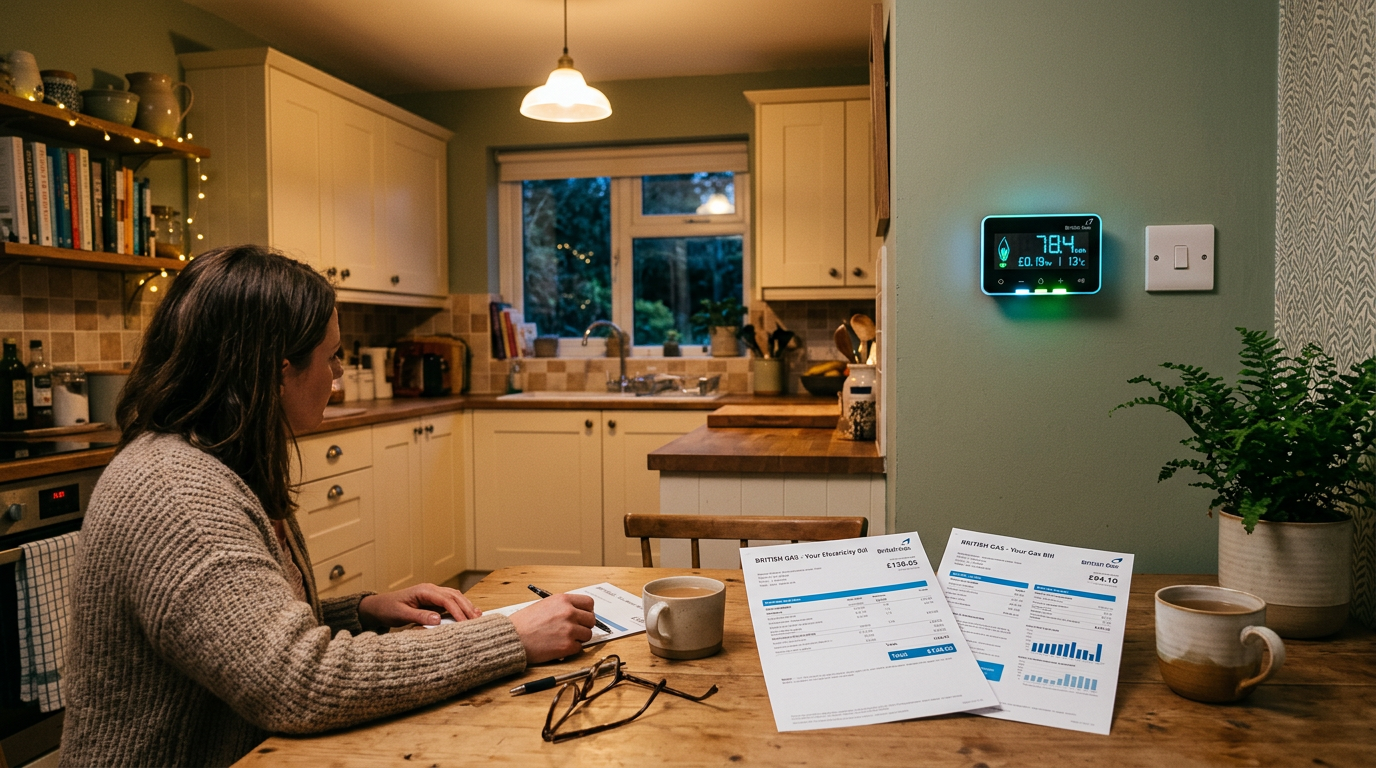
The energy bill has two components: the unit rate — what you pay per kilowatt-hour of electricity or gas you actually use — and the standing charge — a fixed daily amount that applies regardless of consumption. Understanding the distinction matters because it changes how reducing usage affects your bill, and it affects how tariffs should be compared.
What Are Standing Charges?
Standing charges cover the fixed costs of supplying energy to your home — the maintenance of the local network, metering equipment, smart meter rollout costs, some social and environmental levies, and a contribution to the supplier's operational costs. They are expressed in pence per day, and they appear on your bill whether you used energy that day or not.
As of early 2026, the Ofgem price cap sets the maximum standing charges suppliers can apply:
- Electricity: approximately 61p per day
- Gas: approximately 31p per day
This means a typical dual-fuel household pays around £338 per year in standing charges alone, before a single unit of energy is consumed.
Why Have They Risen So Much?
Standing charges have increased significantly since 2021 for several reasons. First, network costs — the maintenance of the transmission and distribution grid — have risen as the system is upgraded to accommodate renewable generation and electric vehicles. Second, social and environmental levies (including costs associated with the Warm Home Discount scheme and support for renewable energy contracts) were shifted from unit rates to standing charges by government policy, partly to reduce the per-unit cost of electricity and encourage electrification of heating and transport.
The effect of this shift is that low-consumption households — those who use little energy, often because they are careful, fuel-poor, or have already invested in efficiency — pay proportionally more through standing charges. The policy has been criticised by consumer groups and energy poverty campaigners on exactly these grounds.
The Impact on Low-Usage Households
For a household using 1,500 kWh of electricity per year (significantly below the Ofgem "typical" consumption of 2,700 kWh), standing charges can represent 40-50% of the total electricity bill. For a household using 4,000 kWh, standing charges represent a much smaller proportion.
This means that energy efficiency improvements — loft insulation, LED lighting, heat pump upgrades — have less impact on total bills than the unit rate alone would suggest, because the standing charge element remains fixed regardless of how much consumption is reduced.
Zero Standing Charge Tariffs
A small number of suppliers offer tariffs with no (or very low) standing charges, instead incorporating those costs into a higher unit rate. These can benefit very low-consumption households — particularly those with their own solar generation — but result in higher bills for typical or high-consumption households.
As of 2026, zero standing charge tariffs are available from some smaller suppliers. They are worth calculating for your specific usage level rather than assuming they will be cheaper or more expensive.
How to Compare Tariffs Properly
Comparison sites typically show a "typical annual cost" based on Ofgem's standard consumption figures. These figures — 2,700 kWh electricity, 11,500 kWh gas — may not reflect your actual usage. To compare tariffs accurately:
- Find your actual annual consumption from your meter readings or smart meter app (or from last year's bills)
- Calculate: (daily standing charge × 365) + (unit rate × annual consumption) for each tariff
- Compare the resulting annual costs
| Household type | Annual electricity use | Standing charge cost/year | Unit cost/year (at 25p/kWh) |
|---|---|---|---|
| Low usage | 1,500 kWh | £223 | £375 |
| Typical | 2,700 kWh | £223 | £675 |
| High usage | 4,500 kWh | £223 | £1,125 |
Prepayment Meters
Prepayment meter customers (who pay upfront via a key, card or smart meter top-up) have historically paid higher unit rates and standing charges than direct debit customers. Ofgem has progressively reduced this disparity, and the price cap from July 2024 removed the prepayment premium entirely on standing charges. However, some rate differences persist, and prepayment meter customers should check that they are on the most favourable available terms.
Practical Action Points
• Check your actual annual consumption (not Ofgem typical figures) before comparing tariffs
• If you have solar panels or very low consumption, calculate whether a zero-standing-charge tariff benefits you
• If you are on a prepayment meter, check whether a smart meter upgrade is available — it widens your tariff options
• The Ofgem price cap is reviewed quarterly; fixed-rate tariffs can save money when unit rates are rising, but lock you in when they fall